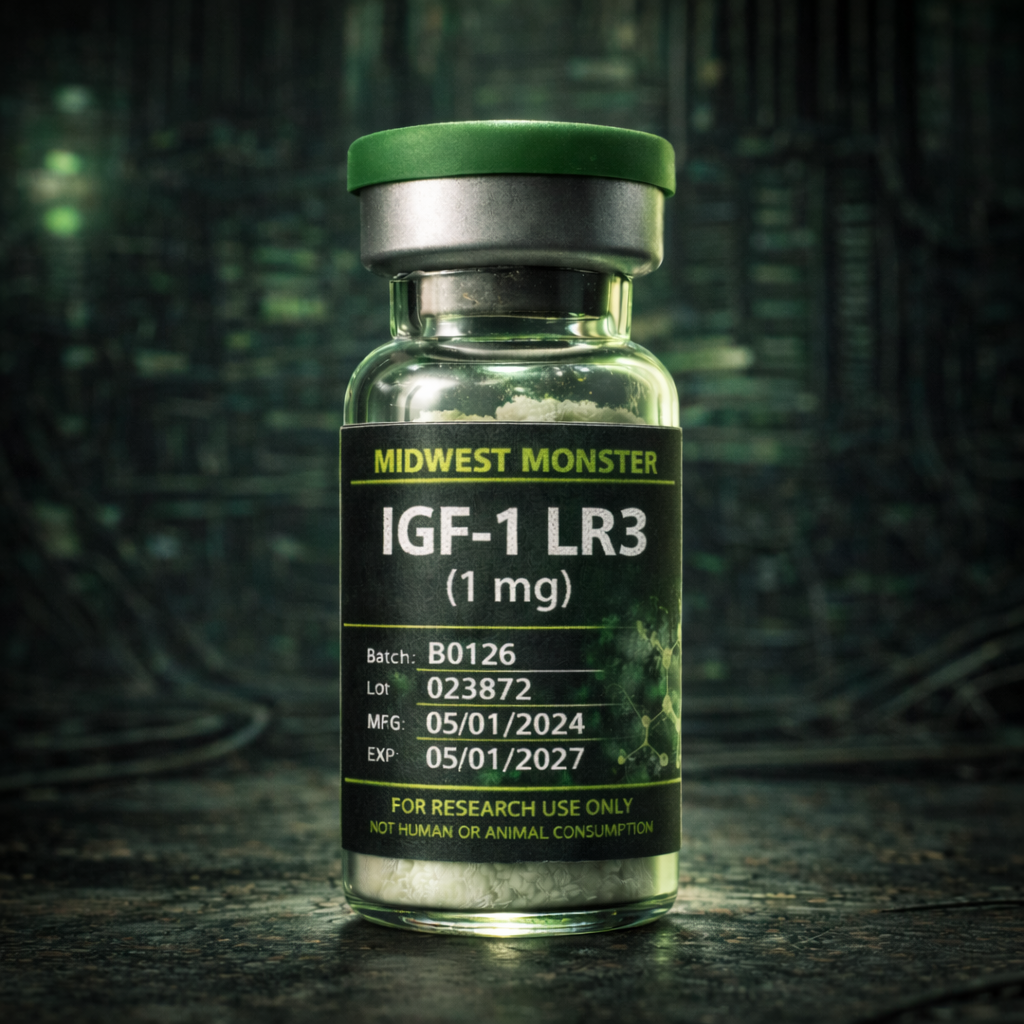
Insulin-like Growth Factor-1 Long Arg3 (IGF-1 LR3) is a modified analogue of insulin-like growth factor-1 that is frequently studied in laboratory research involving cellular growth signaling, tissue development, and metabolic pathways. Due to structural modifications that extend its biological activity, IGF-1 LR3 has become a widely referenced compound in experimental growth factor research.
Researchers investigate IGF-1 LR3 in various models to better understand how growth factor signaling influences cell proliferation, protein synthesis pathways, and tissue regeneration processes.
What Is IGF-1 LR3?
IGF-1 LR3 is a synthetic analogue of insulin-like growth factor-1 (IGF-1). The compound includes a substitution of arginine at position 3 and an extended peptide chain that increases its stability in experimental environments.
These modifications reduce the molecule’s interaction with IGF binding proteins, which normally limit the activity of natural IGF-1 in biological systems. As a result, IGF-1 LR3 demonstrates a longer active duration in laboratory models compared to native IGF-1.
Because of these characteristics, IGF-1 LR3 is often studied when examining prolonged growth factor signaling pathways.
How IGF-1 LR3 Works in Research Models
In biological systems, IGF-1 plays an important role in regulating cellular growth and metabolic signaling. It interacts with IGF-1 receptors located on the surface of cells, triggering intracellular pathways associated with protein synthesis and cell proliferation.
Researchers studying IGF-1 LR3 frequently investigate its involvement in pathways such as:
• cellular growth signaling
• protein synthesis regulation
• muscle cell development models
• tissue regeneration research
• metabolic signaling pathways
Due to its extended half-life relative to native IGF-1, IGF-1 LR3 allows researchers to observe growth factor signaling over longer periods in experimental settings.
Areas of Scientific Interest
Scientific interest in IGF-1 LR3 primarily centers around its potential role in growth factor research. Various experimental studies examine how IGF-related signaling pathways influence cellular behavior and tissue development.
Common areas of investigation include:
• muscle cell differentiation studies
• tissue regeneration research
• metabolic signaling pathways
• growth factor receptor interactions
• cellular repair mechanisms
By examining these processes, researchers aim to better understand how growth factors influence biological development and cellular communication.
IGF-1 vs IGF-1 LR3
While both compounds are related, there are important differences between natural IGF-1 and IGF-1 LR3.
Natural IGF-1 occurs naturally within biological systems and is tightly regulated by binding proteins that control its activity. IGF-1 LR3, however, has been structurally modified to reduce this binding interaction.
This modification allows IGF-1 LR3 to remain active longer in experimental environments, making it useful for extended observation of growth factor signaling pathways.
Research Use Disclaimer
All compounds referenced on this site are intended strictly for laboratory research purposes only.
Products sold by Midwest Monster Peptides are not approved for human consumption, veterinary use, or medical treatment. These materials are intended solely for scientific and laboratory investigation.
Conclusion
IGF-1 LR3 remains a frequently referenced compound in growth factor research due to its structural stability and extended activity in experimental models. By studying IGF-1 LR3, researchers continue exploring how growth factor signaling pathways influence cellular growth, tissue development, and metabolic regulation.
Understanding these biological mechanisms helps expand scientific knowledge surrounding cellular communication and regenerative processes.
Researchers studying IGF-1 LR3 may require high-purity compounds for laboratory investigation. View our IGF-1 LR3 research peptide here.